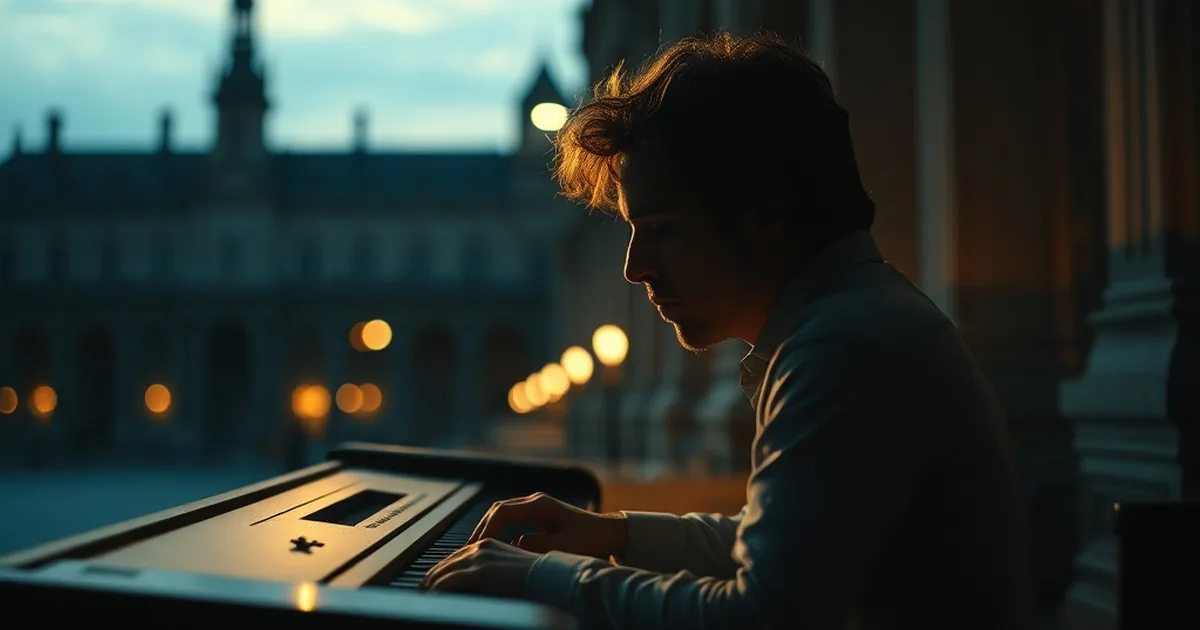
Ludovico Einaudi Cologne: the pianist you already know by heart
You may not know him by name, but you know those few piano notes that rise in "The Intouchables", or the quiet motif that carries through "Nomadland". Goosebumps? That's him. When you type "Ludovico Einaudi Cologne" into a search engine because you've heard the Italian is coming to town, you're really looking for a man whose music has reached millions of people through cinemas, commercials and streaming playlists, yet almost no one would recognise him on the street. The twist: for "Nomadland", the film that won the Oscar for Best Picture in 2021, his music was not even eligible for an Oscar. More on why in a moment.
Ludovico Einaudi Cologne: why this name is suddenly everywhere
Einaudi is the most-streamed classical artist in the world. His minimalist piano music has reached a huge audience through films and playlists, and those searching for "Ludovico Einaudi Cologne" usually want to know two things: is he worth the trip, and how do you get tickets.
The answer to the first question is simple. Even if you've never heard the name, you've almost certainly heard the music of this Italian composer. His sound occupies its own niche between classical, ambient and pop, and that's precisely what makes him accessible to so many people who don't normally connect with classical concerts. The numbers are impressive: with over one million streams per day and several billion streams in total, Einaudi is considered the most-streamed classical artist of all time. Anyone searching "Ludovico Einaudi Cologne" is therefore not looking for a hidden gem, but for one of the most successful musicians of our time. We'll come to the second question, about tickets, at the end, because a live date needs to be checked carefully.
From a Turin living room to the most-streamed composer in the world
Einaudi grew up in a family steeped in culture, studied rigorously in the classical tradition under Luciano Berio, and afterwards found his own, far simpler voice.
He was born in 1955 in Turin, in a household where books and music were part of everyday life. His grandfather Luigi Einaudi was President of Italy between 1948 and 1955, and his father Giulio was a publisher who worked with authors such as Italo Calvino and Primo Levi. He came to music through his mother, an amateur pianist who played for him as a child. From that closeness grew a career that almost no one could have predicted.
Einaudi's training was demanding and classical. He studied at the conservatory, graduated in composition and then went to Luciano Berio, one of the central figures of 20th-century avant-garde music, whose assistant he became. In 1982 he won a scholarship to the Tanglewood Music Festival in the United States, where he encountered American minimalism for the first time - that music of repetition and small shifts that would shape his later style. He initially wrote for ballet, theatre and cinema, as well as numerous pieces for orchestra and ensemble that were performed at La Scala in Milan and at Lincoln Center in New York. In the mid-1980s he began to move away from complex new music and to search for a more personal form of expression.
The turning point came in 1996 with "Le Onde", his first solo piano album, inspired by Virginia Woolf's novel "The Waves". It was a success, particularly in Italy and the United Kingdom. After that things moved quickly, and a single radio moment did the rest: when the title track from "I Giorni" was played on a BBC radio programme, the piece entered the British singles chart - an almost unprecedented event for a purely solo piano work. From then on, Einaudi filled large venues around the globe, from London's Barbican to Carnegie Hall in New York.
The films that made his music immortal
If Einaudi sounds vaguely familiar, it's almost always because of a film. His catalogue is behind some of the most emotional cinema moments of the last twenty years.
Most people will be closest to "The Intouchables", in the original "Intouchables", one of the most successful films in French cinema history. Einaudi contributed pieces such as "Fly", "Writing Poems" and "Una Mattina", and it is precisely those quiet piano moments beneath the calm scenes that you never forget. One piece in particular keeps reappearing: "Nuvole Bianche" featured in "Insidious", in the series "This Is England '86" and in Ricky Gervais' series "Derek". Anyone who has heard that melody once recognises it everywhere.
And then there is "Nomadland", the Oscar winner with Frances McDormand. Director Chloé Zhao found Einaudi in an unusual way. Shortly after filming, she was searching for nature-inspired music and came across a video of the pianist playing in front of an icy landscape. Zhao later described feeling that Einaudi and her wandering protagonist Fern were running in parallel, connected by the same love of nature. She knew his music would suit the film.
This is where the curiosity mentioned at the outset comes into play. The score for "Nomadland" does not contain a single newly composed piece. Zhao drew on already-released recordings, primarily from the album "Seven Days Walking". For a film score to compete at the Oscars in the Best Original Score category, it must consist of around 80 per cent new material. Because all the Einaudi pieces used had already been released beforehand, the music simply did not meet the criteria. The film swept the board, his music featured prominently throughout, but was technically not eligible for nomination. Einaudi himself took it in his stride, saying in essence that it was more important to him to be part of the project than to receive a nomination.
Seven Days Walking and the glacier in the Arctic
Behind the accessible sound lies a concrete idea: Einaudi builds music from repetition and small shifts, often inspired by nature. Two projects illustrate this particularly clearly.
His best-known work of recent years was created while hiking, and the approach is almost documentary in nature. "Seven Days Walking" grew out of a walk in the Alps during which Einaudi spent days in winter walking more or less the same route and observing how the same path slowly changed. From this idea came a seven-part project that was released in 2019 over seven consecutive months, one album per month. Each instalment is named after a day of the journey, and each piece is a variation on the same imaginary motif. The series was recorded in Germany and London, with Einaudi on piano, Redi Hasa on cello and Federico Mecozzi on violin and viola. This very music later became the emotional backbone of "Nomadland".
That nature is more than a pretty motif for him was demonstrated in 2016 with an action that went around the world. For Greenpeace, Einaudi composed "Elegy for the Arctic" and performed the piece on a floating platform in front of a glacier in Svalbard, while ice broke off and plunged into the sea nearby. The performance was part of a campaign to place part of the Arctic Ocean under protection, and it symbolically carried the voices of millions of supporters. It was precisely this video that caught Chloé Zhao's attention years later - a fitting illustration of how closely music, image and landscape are intertwined in Einaudi's work.
What to expect at a Ludovico Einaudi concert
An Einaudi evening is not a loud spectacle but a focused, often meditative experience in which piano, small ensemble and subtle electronics interweave.
His sound is deliberately reduced, meditative, often turned inward, drawing on minimalism, electronics and influences from world music. On stage this means long, slowly building arcs in which a single motif grows, tips and reshapes itself. For new listeners this is the best introduction, because the pieces feel significantly more physical in the hall than through headphones, when the grand piano and strings fill the entire space. Those already familiar with his work find their pleasure in the arrangements, where percussion, cello and electronics gently shift what is already known.
In practical terms: don't put pressure on yourself to place every piece immediately. Let the repetitions work on you - they are the principle, not a lack of ideas. If you're going for the first time, listen through "I Giorni", "Divenire" and "Seven Days Walking" beforehand, so the melodies are familiar and you recognise them live straight away. Those used to classical concert etiquette will feel at home here, and so will those who come more from the pop and film world. You can find an overview of more artists and their performances on our artists page.
Tickets and the Cologne setting
Dates, venues and prices for a specific Einaudi engagement should always be verified through official channels. Cologne offers one of the most vibrant concert settings in Germany.
Briefly and honestly: never rely on secondary sources for the date, venue or ticket price. The reliable points of contact are the official ticket sales and the website of the respective venue, where the exact date, doors, seating plan and price categories are listed. That is also where you will hear first about any additional concerts being announced, which is quite possible with an artist this in demand. Because popular dates sell out quickly, it pays to check early.
Cologne is a strong address for concerts. The range extends from stadiums to intimate halls, and Einaudi fits well within that spectrum. Those looking for a large open-air event can find one, for example, at the BAP - Fünfzig Jahre - Das Jubiläumskonzert 2026 at the RheinEnergieSTADION, a mass event with tens of thousands of attendees. An Einaudi concert works in precisely the opposite way: quieter, more focused, closer to the instrument. Knowing which format you're dealing with helps even when choosing your seat, because with piano every row counts.
So that your evening in Cologne doesn't hinge on a single date, it's worth a look at our events calendar. There you can see at a glance what is happening in the city around your preferred date, from concerts and theatre to smaller formats. And if you want to continue the Italian thread of the evening, a themed wine tasting with antipasti at the vini Lounge pairs well with it. We also bring together the region's larger music festivals in our festival overview.
Frequently asked questions about Ludovico Einaudi in Cologne
Do I need to be a classical music fan to enjoy the concert?
No, not at all. Einaudi's strength is precisely that his music requires no prior knowledge. With his blend of classical, electronics, rock and world music he has dissolved the traditional separation between genres and audiences. Anyone who enjoys film music, or simply appreciates a quiet playlist for reading, is perfectly prepared.
Which pieces should I know beforehand?
The most recognition comes from "Nuvole Bianche" and "Una Mattina", as well as the early albums. A listen through "I Giorni", "Divenire" and the "Seven Days Walking" series gives you a good feel for what his more recent concerts draw on. After that, a single note is usually enough to know where you are.
Why was the music from "Nomadland" not nominated for an Oscar?
Because there was no newly written material involved. Chloé Zhao used already-released Einaudi pieces, primarily from "Seven Days Walking", and a score must consist predominantly of new material to qualify for the Oscar category of Best Original Score. The film itself still won the Oscar for Best Picture.
How does an Einaudi concert differ from a big pop concert?
Considerably. Instead of light shows and a wall of sound, Einaudi relies on quiet, slow build-ups and subtle dynamics between grand piano, strings and electronics. It is an evening for listening and switching off, not a sing-along event, and that is precisely what makes it so special for many people.
How do I find out exactly when and where he is playing in Cologne?
Reliably only through the official ticket sales and the venue's website. The date, exact hall and prices are confirmed there, and that is also where you will hear first about any additional dates. In our calendar you can see in parallel what else is happening in Cologne around your preferred date.
Sources
- Classic FM: Nomadland soundtrack and the Einaudi pieces in the film
- Classical Music (classical-music.com): guide to the Nomadland soundtrack and the Oscar rule
- IndieWire and Irish News: why the music from Nomadland was not Oscar-eligible
- Wise Music Creative and Wise Music Classical: biography, training under Berio, Seven Days Walking and Elegy for the Arctic
- Greenpeace International and Science Smith (Climate in Arts and History): Elegy for the Arctic in Svalbard
- Shore Fire Media and MainlyPiano: streaming figures and the creation of Seven Days Walking
- evental events in Cologne, including BAP - Das Jubiläumskonzert 2026 and wine tasting at the vini Lounge
- Official ticket sales and the venue's website for date, prices and travel information