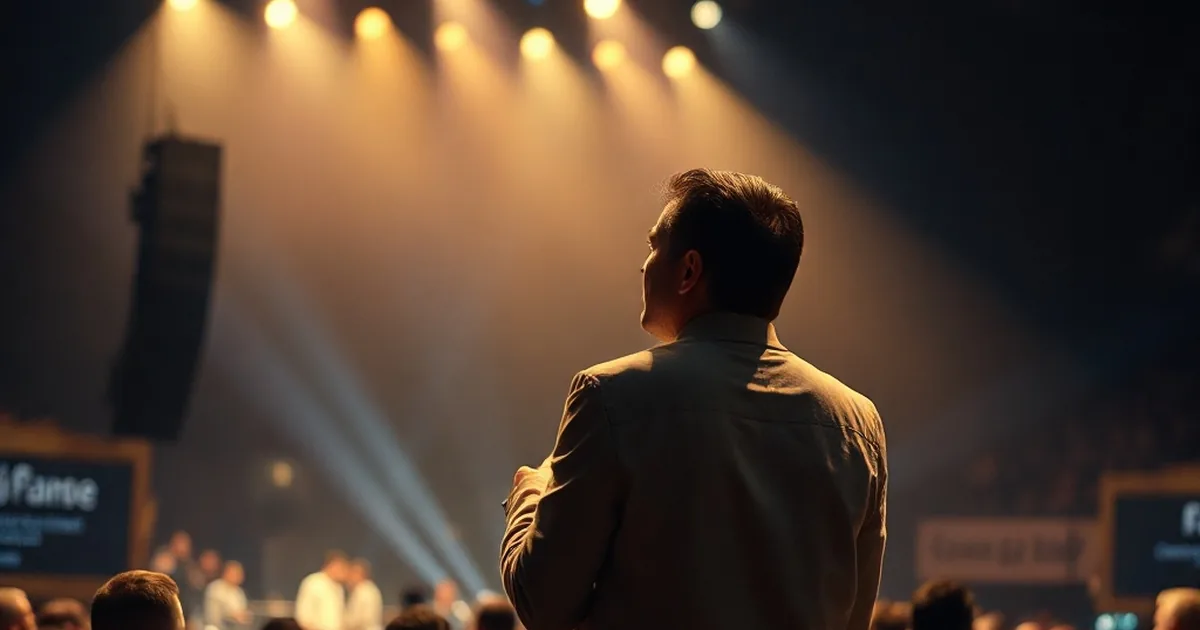
Freddie Mercury candlelight concerts. A tribute to the Queen legend on four Polish stages
Hum the opening bars of "Bohemian Rhapsody" in your head. That quiet "mama..." which moments later explodes into an operatic wall of backing vocals. You know it, even if you've never put a single Queen record on your shelf. And here's a fact that will make you hear that voice differently: a team of scientists from Austria, the Czech Republic and Sweden studied archival recordings and could not confirm the legend of four octaves. The researchers established that Mercury was a natural baritone, although he sang like a tenor with exceptional control over his technique. The secret of his sound lay elsewhere, as we'll explain in a moment. And that is precisely why Freddie Mercury concerts - performed today as tributes, by the light of hundreds of candles - can still give you goosebumps.
In autumn 2026 this format returns to Polish stages under the banner "Freddie Mercury Rock-Opera by Candlelight". Four cities, four different venues, one repertoire the audience knows by heart. Below you'll find the specifics: when, where and what to look out for before you click "buy ticket".
Freddie Mercury candlelight concerts - autumn 2026 schedule
The tour kicks off on 4 September in Bielsko-Biała and ends on 12 September in Świerklaniec. In between there are also Kraków and Wrocław. Four dates, four intimate venues.
Here are the details. The first evening is Freddie Mercury Rock-Opera by Candlelight on 4 September 2026 at the Reduta Hall of the "Pod Orłem" tenement house in Bielsko-Biała. The following day, 5 September, the same programme moves to Kraków, to the Royal Chopin Hall. After a week's break the series resumes: 11 September sees the show at Oratorium Marianum in Wrocław, and the finale falls on 12 September at the Park in Świerklaniec, at the Cavalier's Palace.
It's worth checking the full title at the box office, because on the ticket the event appears exactly as "Freddie Mercury Rock-Opera by Candlelight". This matters because there are plenty of similarly named tributes circulating online and it's easy to end up at the wrong concert. Importantly for planning - each of these venues is an intimate interior, not an arena or stadium, so the number of seats is limited and closeness to the stage is real.
What exactly is a candlelight concert
It's a format in which music is performed live in a hall lit by dozens or hundreds of candles, without stadium effects. All attention goes to the sound and the atmosphere.
The idea is simple and that's precisely why it works: instead of spotlights, smoke and giant screens you get acoustic or intimate arrangements of well-known pieces in a space illuminated by flames. Queen's repertoire sounds different in such a setting than on record - more intimate, with an emphasis on melody and vocal harmonies, and less on guitar weight. This is not a reconstruction of a rock concert. It's more of a look at these songs from an angle that's hard to hear in an arena.
The candlelight format spread around the world mainly through film music and classical repertoire, and here too you'll most often encounter it in that company. If you're curious how the same formula works with different repertoire, a good point of reference is the Candlelight Concerts with music by Hans Zimmer and Ludovico Einaudi - the same idea for an evening, a different composer. The profiles of both artists, Hans Zimmer and Ludovico Einaudi, will give you a sense of what to expect from such a setting.
In the case of Queen's repertoire one thing is key: these are songs written with multi-part vocals in mind. When recording the choral section of "Bohemian Rhapsody" the band layered 160 vocal tracks, with Mercury singing the middle register, May the low, and Taylor the high. A candlelight concert won't reproduce 160 tracks, but it is precisely this harmonic architecture that makes Queen's songs more suited to intimate, vocal treatment than the average rock track.
Why Mercury's voice still makes an impression
The secret wasn't a superhuman range, but an exceptionally fast, slightly irregular vibrato and a rare technique. That's why his singing sounds unlike anything else around it.
Let's return to the open loop from the beginning. If not four octaves, then what? The study confirmed that his range spanned roughly from 92.2 Hz to 784 Hz, that is from a low F#2 to a high G5 - a full three octaves. That's impressive, but doesn't stand out all that much from other good singers. The difference lies elsewhere. Mercury's vocal cords simply vibrated faster than other people's: a typical vibrato oscillates between 5.4 and 6.9 Hz, while his was 7.04 Hz. On top of that it was characteristically uneven, which gave that recognisable, "wild" quality.
The second part of the secret is even more interesting. Scientists discovered that Mercury used subharmonics - a phenomenon in which the false folds in the larynx vibrate together with the vocal folds - which was and still is rare among rock vocalists and is more commonly associated with Tuvan throat singing. Since he had been dead since 1991, the researchers could not study him directly. They therefore brought in a professional rock vocalist who imitated his singing, and filmed his larynx at 4,000 frames per second to see how those growls and vibratos were produced.
There is also an anecdote that ties all of this together in a very human way. Classical soprano Montserrat Caballé recalled that Mercury had a baritone voice. He himself was reluctant to show that lower timbre in public, fearing that fans would not recognise him. For a vocalist who takes on this repertoire at a candlelight concert, that's not a curiosity but a real challenge - this sound cannot be "played louder", it has to be conveyed through technique.
Mercury as a composer - it wasn't just the voice
The Queen frontman wrote most of their biggest hits and did so at the piano, even though he could barely read music. The repertoire you'll hear is largely his own compositions.
It's easy to think of Mercury purely as a showman. Yet he was behind a large part of the catalogue that is performed in tribute today. He wrote 10 of the 17 tracks on Queen's "Greatest Hits" album, including "Bohemian Rhapsody", "Killer Queen", "Somebody to Love", "We Are the Champions", "Don't Stop Me Now" and "Crazy Little Thing Called Love". These are exactly the titles that audiences at such an evening know and wait for.
The way he worked is also surprising. Although he wrote very complex harmonies, he said himself that he could barely read music; he composed most songs at the piano, using a wide range of keys. "Bohemian Rhapsody" took years to develop - he began jotting down ideas while still a student. According to his acquaintance Chris Smith, Mercury began developing the song in the late 1960s, and a fragment known simply as "The Cowboy Song" contained a line that made it into the finished version: "Mama... just killed a man".
What matters for understanding why this repertoire lends itself so well to different arrangements: Mercury did not stick to one genre. The most distinctive feature of his writing was its stylistic diversity - from rockabilly and progressive rock to heavy metal, gospel and disco - because, as he explained himself, he couldn't stand doing the same thing over and over. That's why his songs can be translated into both orchestral grandeur and an intimate candlelit evening without losing their meaning. If you want to trace exactly what came from his hand, visit the profile of Freddie Mercury.
How to prepare and what not to mix up
These are tribute concerts, not a performance by the original Queen, held in intimate venues with a limited number of seats. Buy tickets from the official distributor and don't confuse the event with another "Freddie".
The most important distinction upfront: this is an interpretation of Queen's repertoire, not a reunion of the band. Mercury himself died in 1991, the day after publicly announcing that he had AIDS, at the age of 45. You are going to a tribute - and that is its value, because the performers take on material that for many people is sacred.
The second thing is to stay alert about the name. In the same season you'll find in the Polish calendar, for example, a jazz evening "Sylwester Ostrowski - Freddie Hendrix & Jazz Brigade" in Warsaw. That is a completely different artist and a completely different genre - it has nothing to do with the rock-opera tour. When buying a ticket, check the full title and city from our schedule above, not just the name "Freddie".
Practically speaking: tickets for the four evenings in question are handled by the official distributor, linked at each date. The venues are small, so if a particular city matters to you, don't leave the purchase to the last minute. Arrive early - in intimate interiors, entry and finding your seat takes longer than at a large arena. And if your city falls outside this group of four, check the current events calendar or the concerts section - candlelight formats return regularly and with varied repertoire.
Frequently asked questions
In which cities will the Freddie Mercury candlelight concerts take place?
In autumn 2026 there are four: Bielsko-Biała (4 September, Reduta Hall of the "Pod Orłem" tenement house), Kraków (5 September, Royal Chopin Hall), Wrocław (11 September, Oratorium Marianum) and Świerklaniec (12 September, Park and Cavalier's Palace).
Is this a performance by the original Queen?
No. This is a tribute concert titled "Freddie Mercury Rock-Opera by Candlelight", in which musicians perform the band's repertoire in an intimate, rock-opera setting. Freddie Mercury died in 1991, so every such evening is an interpretation of his work, not a return of the group.
Where can I get tickets?
The safest option is the official distributor - we've linked to it at each date in the schedule above. Since the venues are intimate, the number of seats is limited, so it's better not to wait.
Will it be enjoyable even without knowing Queen?
Yes. The repertoire consists of hits that practically everyone has heard - "Bohemian Rhapsody", "We Are the Champions", "Somebody to Love" - so you'll recognise most of them even if you don't own a single band record. The candlelight format additionally draws out the melody and harmonies from these songs that get lost in the decibels of an arena.
What set Mercury's voice apart from others?
Not the range, though that was wide too, but the technique: a very fast and slightly irregular vibrato and a rare ability among rock vocalists to produce subharmonic sounds. That's why his singing is recognisable after just one phrase.
Sources
- Schedule and venues for "Freddie Mercury Rock-Opera by Candlelight" concerts: evental event pages for Bielsko-Biała, Kraków, Wrocław and Świerklaniec (tickets from the official distributor).
- Voice study: Herbst et al., "Freddie Mercury - acoustic analysis of speaking fundamental frequency, vibrato, and subharmonics", Logopedics Phoniatrics Vocology (2017); coverage in BBC Science Focus and Reverb News.
- Biography and works: Freddie Mercury and Bohemian Rhapsody entries on Wikipedia, Encyclopaedia Britannica, uDiscoverMusic feature on the making of "Bohemian Rhapsody".
- Candlelight format context: event page for Candlelight Concerts - Hans Zimmer, Ludovico Einaudi and Others and the concerts section on evental.