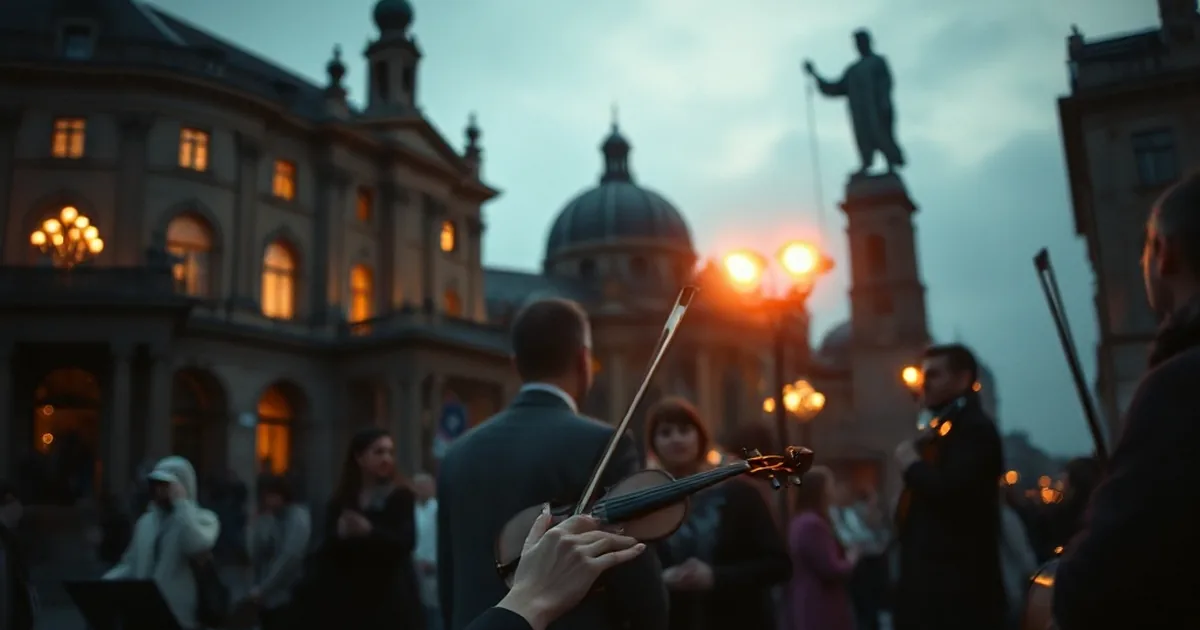
Johannes Brahms concerts in Poland 2026: where and how to hear the master
You don't need to know his date of birth or an opus number to have already heard him. That melody your parents hummed over your crib, the one from music boxes and carousels - that's his "Wiegenlied", Brahms's famous lullaby. Originally a German song, "Wiegenlied: Guten Abend, gute Nacht", published in 1868, it is today perhaps the most recognisable lullaby in the world. And here's something that puts it all in perspective: the very same man was so afraid of Beethoven's shadow that he spent 21 years working on his first symphony. If you're looking for a reason to find out where Johannes Brahms concerts are taking place in Poland in 2026, there it is - the author of a lullaby the whole world knows, and music that only a handful do.
In practice, in the 2026 season Brahms features in one main strand of our concert calendar: the touring series "Royal Concert - The Majesty of Classics (From Strauss to Brahms)", which stops in four cities from June to early autumn. Below you'll find the dates, venues and a short guide so you can walk into the concert knowing what you're listening to.
Johannes Brahms concerts 2026: what you'll actually hear in Poland
In the summer and early autumn of 2026, the series "Royal Concert - The Majesty of Classics (From Strauss to Brahms)" travels through Polish concert halls. It's the surest address if you want to hear Brahms live, and below we explain what to expect from it.
When you type Johannes Brahms concerts into a search engine, you usually mean one of two things: either you're looking for a specific date, or you want to know whether it's worth going at all. Let's start with the calendar. The "From Strauss to Brahms" programme appears in several cities in turn: 27 June at ICE Kraków Congress Centre, then 28 August at the Gorzów Philharmonic, 29 August at the Zielona Góra Philharmonic, and 6 September at the Concert Hall of Radio Wrocław.
The series title itself reveals the concept of the evening: it leads the listener from the light, Viennese elegance of the Strausses towards the denser, more introspective music of Brahms. It's a sensible idea for a first encounter with this composer, because it doesn't throw you straight into the deep end of a forty-minute symphony. If you'd prefer to browse the full classical music offering and compare dates, visit the concerts section, and you'll find the composer's profile on the Johannes Brahms page.
The man behind the lullaby: who was Brahms
The son of a poor musician from Hamburg, a perfectionist who destroyed his own works, and yet one who made it into the very top tier of 19th-century composers as one of the "three Bs".
Contrary to the image of a child prodigy in the mould of Mozart, his start was tough. He was born in 1833 as the son of a musician living in modest circumstances in Hamburg, worked alongside his father and began contributing to the family income early on. To help make ends meet, the young Brahms played piano wherever he could - in taverns and harbour dives.
The turning point came in 1853. While on tour as an accompanist, the twenty-year-old Brahms met the outstanding violinist Joseph Joachim, and through him entered the circle of Robert Schumann and his wife Clara, a gifted pianist and composer. Schumann publicly proclaimed him a genius and anointed him as Beethoven's successor before the young musician had written anything of great significance. His friendship with Clara lasted a lifetime.
It was a double-edged compliment. Brahms remained a maniacal self-critic to the end - he worked slowly, destroyed many manuscripts and left behind a surprisingly small number of early traces. Stories circulate that he burned his own scores because they failed to meet his standards. And yet this was also a man who kept sweets in his pocket for the neighbourhood children and loved good food far more than good clothes. In music history he occupies elegant company: musicians affectionately call him one of the "three Bs", alongside Bach and Beethoven. Notably, he earned his place in that pantheon without having written a single opera, at a time when the rest of the Romantics were fighting over opera stages.
A lullaby with a hidden declaration of love
"Wiegenlied" is more than a music-box melody. Brahms wrote it as a gift for a former love, and in the piano part he concealed a secret counter-melody that only she would recognise.
The story is better than the song itself. Brahms composed the lullaby in 1868 for Bertha Faber, whom he had known from his time conducting a women's choir in Hamburg, and with whom he had once shared something more than friendship. When her second son was born, he gave the family the song as a gift. In a letter to Bertha's husband he joked that while she was lulling the child to sleep, a love song would be singing itself to him. In the piano part he had hidden a counter-melody based on a folk song that Bertha used to hum to him during their walks together years earlier.
The public premiere took place on 22 December 1869 in Vienna, with none other than Clara Schumann at the piano. Originally the piece had only one verse, with words drawn from the German folk-song collection "Des Knaben Wunderhorn". And because Brahms liked to recycle his own ideas, he later wove the lullaby melody in as the second theme of the first movement of his Second Symphony. That's a good sign for anyone who fears that classical music will be nothing but austere and gloomy - in Brahms, even the grand symphonic form can hum something you've known since childhood.
The symphony he feared for 21 years
Brahms's First Symphony took more than two decades to complete under the pressure of comparisons with Beethoven, and conductor Hans von Bülow mockingly dubbed it "Beethoven's Tenth".
This is the heart of the whole story and the best key to understanding why Brahms's music sounds the way it does - serious, dense, carrying the weight of tradition on its back. The composer himself said that from the first sketches to the final revisions the symphony took him 21 years, roughly from 1855 to 1876. The pressure was immense: the entire public was waiting for the genius anointed by Schumann to finally take up Beethoven's legacy. Brahms put it dramatically, writing about what it was like to hear the footsteps of such a giant constantly behind him.
The premiere took place on 4 November 1876 in Karlsruhe - Brahms deliberately chose a quieter, smaller city rather than Vienna or Leipzig. Critics immediately noticed the kinship with the master. Conductor Hans von Bülow called the work "Beethoven's Tenth", because the main theme of the finale recalled the famous "Ode to Joy" from the Ninth Symphony. It irritated Brahms, sounding like an accusation of plagiarism, even though he saw it as a conscious tribute. He dismissed the matter with a famous, cutting remark that any ass could see that.
This tension between reverence for the past and his own voice defines his entire output. In plain terms: in Brahms nothing is for show, every detail serves the whole. That is why his works reward repeated listening rather than losing their appeal. It is worth adding that the first symphony broke the ice - over the following years Brahms wrote three more symphonies, further concertos and two overtures far more readily than he had written that first one.
Four symphonies, a requiem and over 200 songs
Brahms's output consists above all of four symphonies, two piano concertos, a violin concerto, a double concerto, a German requiem, and a vast body of songs and chamber music.
If you're going to a concert and want to know what the programme is likely to contain, it helps to know the landscape. The best-known Brahms comprises four symphonies, two piano concertos, his only violin concerto and a double concerto for violin and cello. He was himself an outstanding pianist, so the piano concertos are particularly close to him, and his violin concerto remains to this day one of the most frequently performed in the repertoire.
Vocal music is a separate chapter, and here lies a second, more private face of the composer. Most of his more than two hundred songs are personal statements - about love, loss and solitude - revealing the reserved, inner Brahms layer by layer. The crown of this part of his output is the German Requiem, which he completed in 1868 following the death of his mother. Importantly, it breaks with convention: instead of the traditional Latin funeral text, Brahms chose words of comfort from Luther's German Bible, addressed more to the living than to the dead, and bypassing dogma. The repertoire also includes his lighter pieces - waltzes and two sets of "Hungarian Dances" for piano four hands. A good lead if you're worried the evening will be entirely solemn.
How to listen to Brahms live: practical tips
Check the programme before you go, start with a symphony or the violin concerto, buy tickets through the official channels listed for the event, and arrive early - at classical concerts latecomers are only admitted during the break between pieces.
The first thing, obvious but crucial: the title of an evening doesn't always tell you everything. The "From Strauss to Brahms" series combines repertoire, so you'll hear more than just Brahms. For a newcomer that's an advantage, because the programme varies in pace and mood. Check the description of the specific event to find out exactly what will be played and who will be on the podium.
Where to begin your journey with this composer? You can't go wrong with any of the four concertos or symphonies. If you like grand, public gestures, aim for the symphonies - but bear in mind that a single Brahms symphony usually lasts close to three quarters of an hour, so it's not background music for coffee. If you prefer a more intimate, chamber atmosphere, reach for the songs or the piano music.
On the subject of tickets: every event in our database has a link to the official point of sale, so buy there rather than from random resellers. Prices and seat availability change over time, which is why we don't list fixed figures here - current rates can be found on the specific event page. One more tip: at symphony concerts silence is observed between movements, so save your applause for the very end of the piece. It sounds rigid, but after two minutes you stop thinking about it and simply listen.
Looking for something in a similar emotional register? In the cinematic-piano repertoire, Candlelight Concerts featuring the music of Hans Zimmer and Ludovico Einaudi at Kliczków Castle are well worth a look, and you'll find profiles of those artists on the Hans Zimmer and Ludovico Einaudi pages. You can browse the full cultural calendar in our events calendar.
Frequently asked questions
Where will concerts featuring Brahms's music take place in Poland in 2026?
The surest address is the series "Royal Concert - The Majesty of Classics (From Strauss to Brahms)", scheduled among other venues in Kraków on 27 June, Gorzów Wielkopolski on 28 August, Zielona Góra on 29 August and Wrocław on 6 September. Dates and venues are taken from our events database.
Do I know any Brahms melody even if I don't know the name?
Almost certainly yes. It's the lullaby "Wiegenlied", hummed over cradles for more than 150 years, played on music boxes and recorded by everyone from opera singers to Bing Crosby and Frank Sinatra. His influence, however, reaches far beyond that one children's melody.
Why is the First Symphony called "Beethoven's Tenth"?
The nickname was coined by conductor Hans von Bülow shortly after the premiere in 1876, owing to audible references to Beethoven - particularly the resemblance of the finale's theme to the "Ode to Joy" from the Ninth Symphony. It irritated Brahms because it sounded like an accusation of borrowing, even though he saw it as a conscious tribute. Interestingly, critic Eduard Hanslick compared the impression made by the first movement to being "beaten by two terribly clever people" - and he said this as an admirer.
How long does such a concert last, and is it suitable for a first encounter with classical music?
Yes, and for a specific reason. The "From Strauss to Brahms" programme mixes lighter Viennese elegance with the more serious Brahms, so your ear isn't thrown straight into the most demanding repertoire. A full symphony concert usually fits into two halves with an interval, and a single Brahms symphony lasts around 45 minutes. It's a gentle entry point, after which it becomes easier to tackle the full symphonies.
Did Brahms write any operas?
No, and that is one of the more interesting facts about his biography. Despite an enormous symphonic, chamber and vocal output, he never wrote an opera or any stage work - which in the Romantic era, when the biggest names were competing for opera stages, was the exception rather than the rule.
Sources
- Events from the evental database: Royal Concert, Kraków (27.06.2026), Gorzów Wielkopolski (28.08.2026), Zielona Góra (29.08.2026), Wrocław (06.09.2026).
- Artist profile: Johannes Brahms and the concerts hub.
- Wikipedia, entries "Symphony No. 1 (Brahms)" and "Wiegenlied (Brahms)".
- Carnegie Hall, "A Guide to Brahms's Symphonies".
- Classic FM, materials on Brahms's symphonies and the lullaby "Cradle Song".
- Orchestra programme notes: New Jersey Symphony, Jacksonville Symphony.