Pitbull Warsaw: who is Mr. Worldwide and why you know him even if you don't realise it
You may not remember the name Armando Christian Pérez, but you know the voice. He's the one shouting "dale", he opens "Timber" with Kesha, his "Give Me Everything" played on every radio station for an entire summer. Bald head, suit, dark glasses and a chorus that stays in your head for three days. The phrase "Pitbull Warsaw" keeps coming up in search engines because Mr. Worldwide's fans regularly look out for him in the capital. And here's a fact that makes you see him differently: he took the nickname from the pitbull breed because those dogs, as he himself said, "bite to lock", are "too stupid to lose" and are banned in Dade County.
That's no meme joke. Pérez has built one of the most recognisable brands in pop over the last two decades, and his hits are known even by someone who has never consciously put on one of his albums. Even if you don't know the titles of his songs, you've probably danced to Pitbull more than once. In this piece we'll break him down: where he came from, how he reached the top and what his concert looks like when only the hits remain.
Pitbull Warsaw: what you really need to know
In short: Pitbull is an artist built for stadiums and festivals, and his set is essentially a playlist of radio certainties. If you're looking for a specific date in the capital, keep an eye on official channels and our calendar, because this is a format that appears and disappears from tour schedules in a flash.
Let's start with the basics. The phrase "Pitbull Warsaw" is above all a question from fans who want to know whether and when Mr. Worldwide will play by the Vistula. Pérez doesn't come with an intimate recital, because his music is written for big arenas, two hours of partying and a crowd singing choruses together. That's why the most reliable sources of truth are official promoters and authorised ticket distributors, not screenshots circulating online. The most convenient way to follow current dates for major concerts in the capital is through our events calendar and the concerts section. And before any date appears, it's worth knowing who exactly you'd be seeing on stage.
Who is the man who calls himself Mr. Worldwide
In short: Pitbull is a Miami-born son of Cuban immigrants who went from a kid reciting a Cuban poet to a global brand. "Mr. 305" is the area code for Miami; "Mr. Worldwide" is the rest of the planet.
Pérez was born on 15 January 1981 in Miami, Florida, as a first-generation American, the son of Cuban immigrants; his mother Alysha arrived in the USA in early 1962 as part of Operation Peter Pan. His father emigrated in the late 1970s and later helped ferry compatriots to American shores during the exodus from the port of Mariel in 1980. Home life was not easy. Pitbull moved frequently as his mother looked for work, at one point ending up in foster care in Roswell, Georgia, and after returning to Miami he himself got involved in drug dealing, which led his mother to throw him out of the house when he was 16.
And yet he had something inside him that money can't buy. At the age of three he could recite, in Spanish, works by José Martí, Cuba's national hero and poet. There is also a detail that says everything about starting from zero: he learned English by watching Sesame Street. Growing up, he absorbed the miami bass genre, and cited Celia Cruz and Willy Chirino as inspirations. That's where his instinct for melody and bilingual choruses comes from. And the nickname? He chose "Pitbull" because dogs of that breed "bite to lock", "are too stupid to lose", are banned in Dade County and, as he put it, "that's basically what I am. It was a constant struggle".
Over time he acquired a second nickname that explains his entire strategy. "Mr. 305" is a nod to Miami's area code, while "Mr. Worldwide" underlines that his music has crossed borders. He put it more simply himself: "Mr. 305 got promoted to Mr. Worldwide," he told American Way magazine in 2017.
From the streets of Miami to a hit machine
In short: he started as a street rapper doing battle rap and crunk, and ended up as the king of club pop. The breakthrough came in 2009, and from there it only accelerated.
His career was launched by a single connection. Pitbull appeared on Lil Jon's album "Kings of Crunk" in 2002. A year later his track "Oye" appeared on the soundtrack of the film "2 Fast 2 Furious". He honed his lyrical skills in battle raps on the streets of Miami, and the regional buzz led to the release of his debut album "M.I.A.M.I." in 2004. The way he was developed back then says a lot about his later trajectory. In 2001 he met Robert Fernandez from an independent label and management company who, as he recounted, "saw his hunger and drive" and began working with him.
The shift from street rap to club pop turned out to be a bull's-eye. His fourth album "Pitbull Starring in Rebelution" from 2009 brought a commercial breakthrough, with singles "I Know You Want Me (Calle Ocho)" and "Hotel Room Service" reaching number two and number eight on the Billboard Hot 100. Within a few years the bilingual rapper had refined his club sound and powered a series of Top 10 hits from albums such as "Planet Pit" in 2011 and "Global Warming" in 2012. Then it snowballed. Three months after its release, in 2011, "Give Me Everything" became Pitbull's first single to top the Billboard Hot 100.
His biggest hit literally circled the globe. The 2013 track "Timber", from the EP "Meltdown", reached the top of the charts in twenty countries, including the USA and the UK. Along the way he worked with some serious names. Together with Jennifer Lopez and Claudia Leitte he recorded "We Are One (Ole Ola)", the official anthem of the 2014 FIFA World Cup in Brazil. And the overall scale impresses even sceptics. Pitbull has sold over 25 million studio albums and over 100 million singles worldwide, with more than 15 billion views on YouTube. In 2016 he added a Grammy Award for Best Latin, Rock, Urban or Alternative Album, for the record "Dale".
What to expect at a Pitbull concert
In short: this is not an evening for focused listening, but two hours of partying with a set made up almost entirely of radio certainties. Come ready to sing unfamiliar words in Spanish.
Pérez's repertoire has one advantage over many stars: you already know almost every track, even if you don't know it's him. From "I Know You Want Me" through "Give Me Everything" to "Timber", it's hit after hit, and the choruses are simple enough that an entire section picks them up on the first go. Also characteristic is the live mixing of languages, as Pitbull switches between English and Spanish within a single song. He himself is clear about the aim: he wants the audience to "feel good" and for those two hours simply "escape" from everyday life.
Many of his biggest numbers are duets, so live the guest parts are usually sung by the audience or a vocalist from the band. His catalogue includes collaborations with stars such as Jennifer Lopez, Usher, Christina Aguilera, Chris Brown, Kesha and Shakira. Your role as a backing choir is written into the ticket.
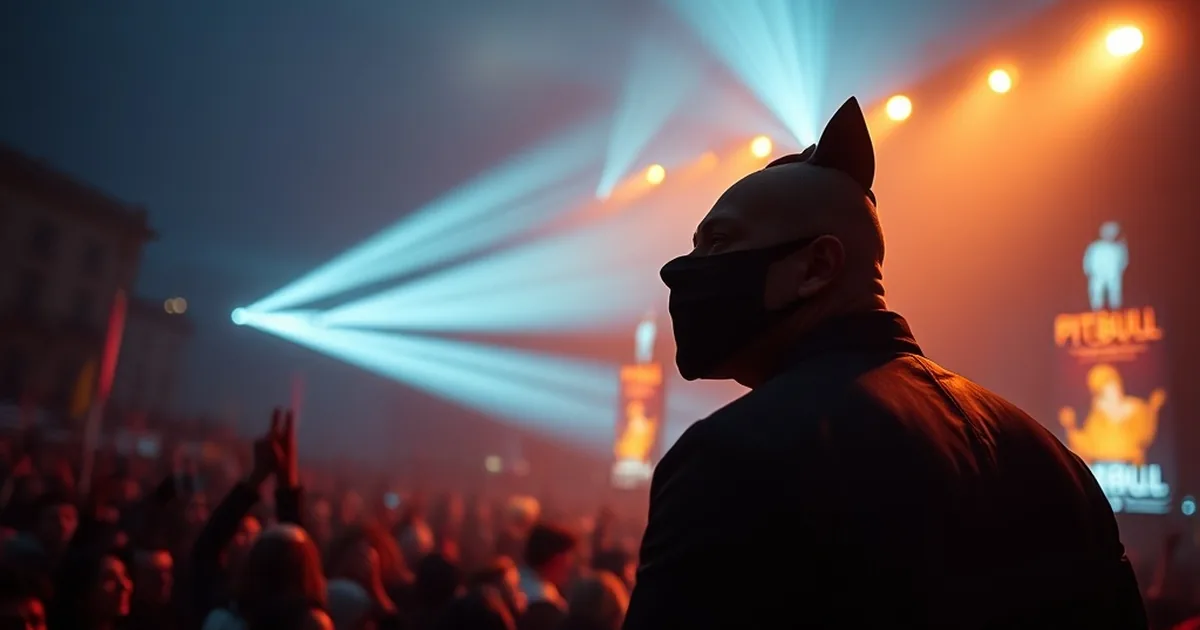
There is also an element that turns these concerts into a social sport. Among fans there is a saying that "a bald cap and a suit are the officially unofficial dress code for Pitbull concerts". Why a suit on stage? Pérez explained it not as fashion but as a message. He said he made music to get off the street, not to stay on it, and that suits are meant to show maturity, growth and evolution. So if you see an army of "bald" Pérezes in blazers in the stands, that's no accident - it's a permanent feature of the fandom.
Why you know him even though you don't know him
In short: Pitbull stopped being just a rapper a long time ago. He's a brand, a businessman and an activist who turned his millions into a school and investments, and his name into a quite literal sign.
The scale of his presence in pop culture is hard to miss. Billboard ranked him as the 45th artist of the 2010s decade. He converted the money from music into something more lasting. In 2013 he played an important role in the founding of the SLAM charter school in Miami's Little Havana neighbourhood, focused on education with an emphasis on sports management. He also built an empire beyond the stage. In 2024 he signed a 12-million-dollar naming-rights deal with Florida International University's stadium, which was renamed Pitbull Stadium - the first time a university sports facility had been named after a musician.
All of this adds up to the portrait of an artist who is not trying to be the most ambitious lyricist in the business, but the most effective supplier of good vibes. And that's precisely why his concert works even for someone who arrived sceptical and left hoarse.
What's on in Warsaw right now
In short: if you're waiting for a big concert in the capital, your calendar is packed regardless. Stadium rap, Polish hip-hop and classics are all within reach, so the atmosphere of a major event is available on more than one stage.
The energy of a big concert that Pitbull whips up in the stands has many relatives in Warsaw. At Legia's venues you can see, among others, Malik Montana and kuqe 2115, so if you like a stadium beat and a crowd singing choruses, these events are close to your taste. From the Polish rap scene, our artist catalogue also features Quebonafide, whose work makes for an interesting counterpoint to Pérez's simple, party-ready choruses.
If between one loud evening and the next you fancy something completely different, the capital delivers with classics and theatre. For a baroque alternative there is a concert of Vivaldi's "Four Seasons", and the intimate theatre repertoire includes the production "The Shy Jockey". The contrast with the noise of the stage can be the best part of a trip like that.
Frequently asked questions
Who exactly is Pitbull?
He is American rapper and singer Armando Christian Pérez, known as Mr. 305 and Mr. Worldwide. He was born on 15 January 1981 in Miami as the son of Cuban immigrants. He became famous for energetic party anthems and bilingual choruses that broke through far beyond the USA.
Where do the nickname Pitbull and the alias Mr. Worldwide come from?
The nickname refers to dogs that in his view "are too stupid to lose", which Pérez relates to his own stubbornness and constant struggle. "Mr. 305" comes from Miami's area code, and "Mr. Worldwide" underlines the global reach of his music.
What songs does Pitbull usually play at concerts?
The core of the set is his biggest hits, from "I Know You Want Me" through "Give Me Everything" to "Timber" and "Feel This Moment". "Timber" alone reached the top of the charts in twenty countries, making it one of the obligatory highlights of every show.
Is it a good concert for someone who doesn't know his work?
Paradoxically, yes. Even if you don't recognise the titles, you've probably danced to Pitbull more than once. It's music written for singing together, not for connoisseurs, so live you'll quickly get what it's all about.
Where should I check concert dates in Warsaw?
Best to go to official promoter channels and authorised ticket distributors, because with stars of this calibre there are always second-hand offers and fakes. Current dates for major events can also be found in our events calendar and in the concerts section.
Sources
- Wikipedia (EN), entry "Pitbull (rapper)" - discography, biographical data, Pitbull Stadium contract
- Biography.com - profile of Armando Christian Pérez, childhood in Miami, family background
- IMDb - biography and career timeline, "Timber", "We Are One (Ole Ola)"
- American Songwriter, Irish Star, CNN, cheatsheet.com - origins of the nickname and aliases Mr. 305 / Mr. Worldwide
- The Richest, Contactmusic - career, sales, educational activity (SLAM)
- evental.eu - concerts in Warsaw, events calendar, Malik Montana, kuqe 2115, Four Seasons - Antonio Vivaldi