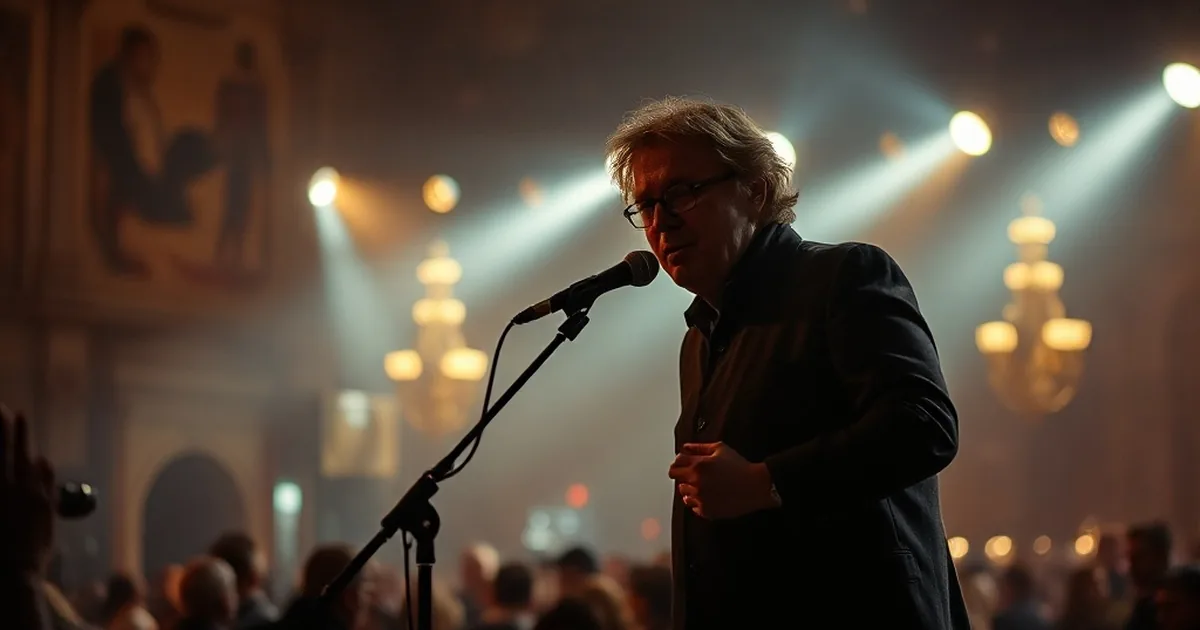
Ernst Molden Concerts 2026: Vienna, Linz and the Man Who Reinvents the Viennese Song
Maybe the name means nothing to you. But imagine a voice that makes Vienna sound as raw and dark as Tom Waits singing about the American South: backyard poetry, a dry wit, songs from the half-shadow of the city. That is Ernst Molden. Anyone who googles "Ernst Molden concerts" lands on the first Austrian musician ever to have won the German Song Prize. In 2015 he took home the German Song Prize for the "most significant song in the German language" (Ho Rugg), as the first Austrian musician to do so. Awarded for a song that most Germans can barely understand word for word, because it is sung in the broadest Viennese dialect.
One more detail you would not expect from this man: before he wrote songs, he wrote police reports. After dropping out of his German studies, Molden began working as a police reporter from 1987 and subsequently as a supplement editor for the daily newspaper "Die Presse". From the courtroom to the dimly lit taverns of the city: you can hear that journey in every one of his pieces. And the next stop on the map is Vienna again.
Ernst Molden Concerts 2026: the Dates and the Next Stop in Vienna
In 2026 Molden is on the road in several line-ups. The next confirmed date in the calendar is at the end of June in Vienna, followed by Linz at the beginning of July and Vienna again in midsummer.
Anyone planning a Molden evening should know one thing: the man rarely stands on stage alone, but almost always with a partner or a full ensemble. Three dates stand out for 2026. The opening night is Ursula Strauss & Ernst Molden - Nochdvegl on 28 June 2026 at the Theater im Park in Vienna. Two voices, one guitar, Viennese material in song form.
A few days later things get fuller: Molden & das Frauenorchester - schduam plays on 3 July 2026 on the FrischLuft stage of the POSTHOF in Linz. And in midsummer he returns to Vienna, this time alongside the Dutch blues guitarist: Hans Theessink & Ernst Molden on 21 July 2026, again at the Theater im Park. The fact that he constantly switches between such constellations is no coincidence, but a deliberate approach. The Oberösterreichische Nachrichten simply calls him "the outstanding Austrian singer-songwriter of the present day", a gifted storyteller from Vienna.
Who Is Ernst Molden, and Why Is He Called the Leonard Cohen of Vienna?
Molden, born in 1967, comes from a Viennese literary and publishing family and is today one of the most formative singer-songwriters in Austria. He owes the nickname to Falter, because his songs emerge from the urban half-shadow.
His origins are not a minor detail here, but part of the point. Molden is the son of publisher Fritz Molden and the grandson of Paula von Preradović, the lyricist of the Austrian national anthem, and of Ernst Molden, the former editor-in-chief of the Neue Freie Presse. The grandson of the woman who wrote the text of the national anthem now sings about gallows, water spirits and suburban alleyways. The magazine profil even placed the family in the same league as the Manns in Germany and the Kennedys in the USA in 2022. The Viennese dialect, however, was by no means a given in his parental home: Ernst Molden learned Viennese from his maternal grandmother, who looked after him a great deal during his childhood.
He has carried the nickname for years. Thematically, the "Leonard Cohen of Vienna" (as Falter calls him) draws preferably from the rich urban mythology of the Danube metropolis, but also from his private surroundings. What makes his music so distinctive is a trick you barely notice consciously. The musical backdrop combines Molden's long experience with electric blues with delicately placed local colour, even if it is just a diminished chord that almost imperceptibly transports a rock ballad built on a US template to Ottakring.
His mentors are no secret. Molden himself once said: "I see myself in the tradition of Georg Danzer or Wolfgang Ambros. American folk and blues have also shaped me." The same dual nature shows up in his cover versions: Much-noted are his Viennese-dialect renditions of songs by Bob Dylan, Johnny Cash, Nick Cave, Tom Waits, Townes van Zandt and Udo Lindenberg. Half Viennese Schrammel, half American songwriter: that runs through his entire body of work.
From Police Reporter to Viennese Song: an Unusual Path
Molden came to music via literature and theatre. He first sang in standard German, then found his way to the dialect that is now his natural language on stage.
Before the music came the word. After his years as a reporter he moved to the theatre: from 1991 to 1993 Molden was dramaturg and house author under Hans Gratzer at the Wiener Schauspielhaus; from 1993 he worked as a musician and writer and has since written numerous short stories, feuilletons, columns, two theatre plays, four novels and three essay collections. The musical turning point came gradually. At first, as one album sleeve note once put it, he brought the standard-German art song down into the cellar vault rather than opening himself up to the dialect.
A key scene in his career takes place in the nineties, at a Viennese songwriting course. The love song is a central pillar in Molden's work, at the latest since he attended Nick Cave's class at the Schule für Dichtung in the nineties, where Cave explained under the title "The Lovesong and How to Write One" that there was no nobler art than writing a love song. The decisive step towards the dialect, however, came only through a friendship that would shape his career. In 2007 an intensive collaboration with Viennese rock legend Willi Resetarits began. As a result, Molden wrote songs primarily in the Viennese dialect.
The spark flew during a radio programme. It was an encounter with Willi Resetarits, whose guest he was on the radio show "Trost und Rat", that led Molden to write his own songs no longer in his second, standard-German language of distance, but without a filter in the Viennese dialect. Resetarits, once famous as Kurt Ostbahn, became his most important companion. Of Molden he said simply that he was "the best singer-songwriter on God's earth".
Why Viennese dialect specifically? Because the dialect demands its own discipline. The dialect forces Molden to the greatest precision. High-flown formulations that may have something lyrical and breezy about them in standard German crash down like lead in the dialect. It is precisely this friction that makes his lyrics so dense. The fact that the same man has also translated an "Asterix" comic into Viennese dialect ("Kööch uman Asterix") fits the picture of an artist who plays with language the way others play with Lego.
What Line-ups Molden Performs In
No two Molden concerts are alike. Solo, in a duo with Ursula Strauss or Hans Theessink, with a band or with the Frauenorchester. The line-up determines the character of the evening.
This is perhaps the most important thing to know before buying a ticket: you are not simply booking "Ernst Molden", but a very specific constellation. Molden performs in a wide variety of line-ups: solo, in a duo with Nino aus Wien or Hans Theessink, with Ursula Strauss or a full band, with the Frauenorchester or with Maria Petrova. He also appears regularly on stage with Christopher Seiler or the Neue Wiener Concert Schrammeln.
The collaboration with actress Ursula Strauss has been the most widely noted of recent years. With Ursula Strauss he released the album "Wüdnis" in 2020. The duo strips the songs down to the essentials, two voices and acoustic guitar, and that is precisely where the appeal lies. Together the two have also brought the Viennese song project Remassuri to the stage: The project "Remassuri" by André Heller, Ursula Strauss and Ernst Molden offers an unusual journey through the world of the Viennese song at the Stadttheater Walfischgasse.
Quite different is the evening with the Frauenorchester in Linz, where the sound becomes broader and more orchestral. And different again is the meeting with Hans Theessink, where two very different approaches to the blues come together. How productively Molden works in such partnerships is shown by the series with Nino aus Wien: With the programme "Unser Österreich" alone the two played 140 concerts. Anyone who wants to know more about the artist and his dates will find an overview on the artist page for Ernst Molden.
What to Expect at a Molden Evening
Do not expect a show, but a narrative. Molden opens the city like a book, the tone oscillates between melancholy and dry wit, and the acoustic guitar is usually at the centre.
Anyone attending one of the Ernst Molden concerts for the first time should let themselves be drawn into the lyrics, even if not every dialect word lands immediately. That is precisely part of the game, and it works surprisingly well. Of the Viennese song in general it is aptly said that it reveals a deep insight into the Viennese soul, even for people who do not understand the dialect of the lyrics. Added to that is a healthy dose of humour and fatalism that is characteristic of this music.
Molden is today one of the central figures of an entire movement. Musicians such as Marco Wanda, Willi Resetarits, Ernst Molden, Nino aus Wien and Voodoo Jürgens are transforming the venerable Viennese song into a raw, gritty pop language, entirely without glamour or showmanship. The city itself sees him as a permanent part of its musical history. Vienna Tourism puts it this way: The Viennese song composer Ernst Molden is firmly inscribed in the musical DNA of the city.
How close Molden can be to his audience was demonstrated in a curious way during the first lockdown. On the balcony of his flat in Vienna-Erdberg, Molden held a total of 20 balcony concerts, which received wide media coverage. Musically his range extends from the quiet ballad to the blues number, from the city portrait to the Danube hymn: The album "Schdrom", for example, is dedicated to the great river, the Danube, through whose wilderness behind Vienna he roamed for a summer. In the duo format intimacy dominates; at the orchestral evening the sound becomes fuller. Anyone looking for the full programme of live music in Austria will find it in the overview of concerts.
Tickets, Getting There and Practical Tips
The 2026 dates take place in manageable venues, which makes booking early worthwhile. Tickets are available through the official sales outlets, which the event pages link to directly.
Two of the three Molden dates in 2026 are at the Theater im Park in Vienna, one on the FrischLuft stage of the POSTHOF in Linz. These are not stadium concerts, but evenings with clear sightlines and good acoustics. For the Viennese song that is ideal, because a genre of this kind unfolds best at close range. As Vienna Tourism describes it: The best way to explore the genre is to dive in at a live show, where the audience experiences the musicians up close in often intimate venues. Such formats, however, often sell out faster than expected.
The best way to buy tickets is through the respective event page, which links to the official advance booking. For the opening date that is Ursula Strauss & Ernst Molden - Nochdvegl on 28 June in Vienna, followed by Molden & das Frauenorchester - schduam in Linz and Hans Theessink with Molden on 21 July in Vienna again. Anyone with flexibility can compare the three line-ups and then decide whether to go for the intimate duo evening or the orchestral performance. A full overview of further dates in Austria can be found in the events calendar.
Frequently Asked Questions about Ernst Molden Concerts
The most important questions about language, line-up and dates answered briefly.
Do I need to understand Viennese dialect to enjoy a concert?
No. Molden sings predominantly in dialect, but the music carries the atmosphere even when the odd word escapes you. The Viennese song offers an insight into the soul of the city, even if you do not decode every word of the dialect. If you like, listen to the album wüdnis beforehand - it makes following along even easier.
Does Molden always play the same programme?
Definitely not. He performs solo, in a duo with Ursula Strauss or Hans Theessink, and with the Frauenorchester, and each line-up brings its own character. So look carefully at which evening is being announced, because the Theater im Park concert with Ursula Strauss sounds fundamentally different from the orchestral evening in Linz.
When and where are the next concerts in 2026?
The next date is 28 June 2026 at the Theater im Park in Vienna, followed by Linz on 3 July and Vienna again on 21 July. All three evenings take place in medium-sized venues, so getting a ticket early is worthwhile.
Why is Molden considered so significant when he has almost no radio hits?
Because he was the first Austrian to win the German Song Prize for the most significant German-language song, and Resetarits even called him the best singer-songwriter on God's earth. His influence on the new Viennese song scene around Voodoo Jürgens and Nino aus Wien is considerable, even if his name sounds less loud in the mainstream.
Is it worth going for non-Austrians?
Absolutely. Solo and in changing formations, Molden has repeatedly toured Austria and the German-speaking world. His mix of American songwriting and Viennese material works wherever people are open to atmosphere and storytelling. The dialect is less a barrier than a seasoning.
Sources
- Event data and tickets: Ursula Strauss & Ernst Molden - Nochdvegl (28.06.2026, Theater im Park, Vienna)
- Molden & das Frauenorchester - schduam (03.07.2026, POSTHOF FrischLuft stage, Linz)
- Hans Theessink & Ernst Molden (21.07.2026, Theater im Park, Vienna)
- Artist pages: Ernst Molden, Molden & das Frauenorchester, Ursula Strauss
- Background: Österreichisches Musiklexikon (musiklexikon.ac.at), Wikipedia article on Ernst Molden, mica - music austria (musicaustria.at), Hanser Literaturverlage, profil.at, wien.info, Schule für Dichtung (sfd.at)
- Further dates: Events calendar and Concerts