Summerwinds Festival: Van Wauwe, Dörken - From Broadway to Buenos Aires
Haus Siekmann, Sendenhorst, Germany


Foto: Spotify
Annelien Van Wauwe, clarinet
Danae Dörken, piano
There is an America where freedom means the chance to belong to the cultural mainstream - or to be diverse and open, to be together and build something new from that. "Without doubt", Antonín Dvořák observed in 1895, "the seeds of the finest music lie hidden in all the races that mingle in this great country."
Annelien Van Wauwe and Danae Dörken trace that "American Sound" in their programme "From Broadway to Buenos Aires". The Belgian clarinettist and the German-Greek pianist rank among the leading instrumentalists of their generation - open-minded, energetic, equally at home in classical and jazz idioms.
Jazz and the classical American modernist tradition grew from European classical music, Afro- and Latin American roots, Jewish heritage, and US folk. The 25-year-old Bernstein was finding his own hybrid voice in 1941/42 - just as the United States entered the Second World War - with his Clarinet Sonata, which already hints at the Broadway sound of "West Side Story".
Aaron Copland, who shaped the American sound alongside George Gershwin, wrote his Clarinet Sonata in 1943 in response to the death of a friend shot down over the Pacific. The first movement rises like a sunrise over vast open land, conveying "the values at stake: peace, civilization and freedom" (H. Pollack). Solemn remembrance in the second movement; in the finale, momentum and lyrical eloquence that dissolve into silence. Warm blues scales, Latin habanera echoes, and a sparkling scherzo finale in Gershwin's jazzy Preludes of 1926.
In 1962 Poulenc wrote his Clarinet Sonata for Benny Goodman, who premiered it in 1963 - after Poulenc's death - with Bernstein at Carnegie Hall. Lightly jazz-tinged, it moves between irony and melancholy, graceful farewell and vulnerable openness, ending with lightness and a wry Parisian esprit. Paquito D'R
Events
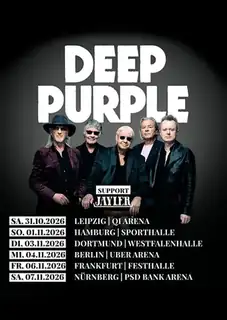 100concertSat 31.10.Deep Purple in Germany 2026
 100concertSun 1.11.Deep Purple - SPLAT! World Tour 2026
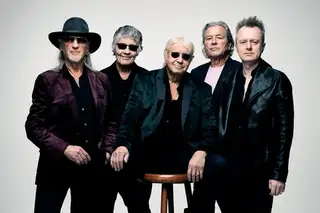 100concertSun 1.11.Deep Purple in Hamburg: MAD IN EUROPE
 95stand-upSun 8.11.Bodo Wartke - Wunderpunkt
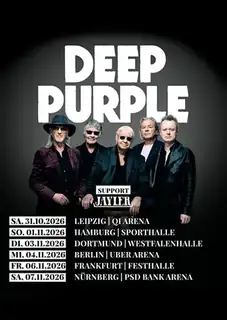 100concertTue 3.11.Deep Purple in Germany 2026
 100concertWed 4.11.Deep Purple - SPLAT! World Tour 2026
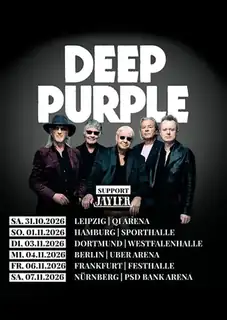 100concertFri 6.11.Deep Purple in Germany 2026
 100concertSat 7.11.Deep Purple - SPLAT! World Tour 2026
 100concertThu 19.11.David Bowie Symphony - The Celebration Concert
 100concertSat 28.11.Nights on Broadway - A Tribute to the Bee Gees performed by Night Fever
 100concertSun 29.11.Tori Kelly - God Must Really Love Me Europe Tour
 100concertThu 17.6.Die Toten Hosen - Trink aus! Wir müssen gehen - Tour 2027